
History of the Old Egyptians: From Nile Villages to Pharaohs and Pyramids
Over 3,000 years is a long time for any civilization to stay standing. Yet Ancient Egypt did it, from small mud-brick villages to stone pyramids that still tower over the desert today.
When people say they love the “old Egyptians,” they usually think of pyramids, mummies, gold masks, and mysterious tombs. Behind all that, though, is a long, layered story of kings, farmers, scribes, and builders. This post walks through the main time periods, a few unforgettable rulers, and how we even know their names today, all in simple language, like you are chatting with a friend who likes cool history facts but hates boring date lists.
Who Were the Old Egyptians and Why Does Their History Matter?
The old Egyptians were the people who lived along the Nile River in northeast Africa, in what is now modern Egypt. Their civilization grew around 5000 BCE and lasted until the Romans took control in 30 BCE, which is longer than the entire time between the Roman Empire and us.
Their story matters because they left behind so much. Egyptian art shaped later cultures, their temples inspired architects, their early medicine helped later doctors, and their religious ideas about the soul and the afterlife still show up in movies, books, and even in how people imagine mummies today.
They also created one of the first large-scale writing systems. Without Egyptian hieroglyphs, we would know far less about how early states worked, how kings ruled, and how everyday people lived. For a quick, kid-friendly summary of this big picture, National Geographic Kids has a helpful guide to ancient Egypt.
Life along the Nile River in ancient times
To understand the old Egyptians, start with the Nile. The river flooded every year, usually in late summer. The water dropped a layer of rich, dark silt on the fields. That silt was perfect for growing wheat, barley, and flax.
Farmers planned their lives around three seasons: the flood, planting time, and harvest. Villages and cities lined the riverbanks, because the Nile gave them water, food, and a travel route. Boats carried goods and people up and down the river, like a long highway of water.
The Nile was not just a resource, it felt sacred. The Egyptians even had a god of the flood, Hapy. If you want to see how much the floods mattered, check out this piece on why ancient Egyptians needed the flooding of the Nile.
This stable river life helped Egypt stay united and fairly rich for thousands of years.
A quick look at how long Ancient Egypt lasted
Ancient Egypt did not appear overnight. Early farmers settled along the Nile by around 5000 BCE. Over time, small groups joined into larger chiefdoms and, eventually, into one kingdom.
Historians usually split Egyptian history into big chunks: the Old Kingdom, Middle Kingdom, New Kingdom, and later periods, with “Intermediate Periods” of trouble in between. You can see a simple breakdown in this overview of the three kingdoms of Ancient Egypt or explore a broader timeline of ancient Egypt from the British Museum.
That long stretch of time is why the history of the old Egyptians feels so deep and complex. You are not looking at one kingdom, but wave after wave of change.
Key Periods in the History of the Old Egyptians
Egypt’s story is easier to follow if you think of it as a series of big phases, not a list of dates.
From small villages to one united kingdom
Before there were pharaohs, there were farmers. In the Predynastic period, people lived in small village groups along the Nile. They buried their dead in simple graves, made pottery by hand, and traded beads, tools, and food up and down the river.
Over time, some leaders grew more powerful than others. They controlled trade, gathered soldiers, and built bigger tombs for themselves. Eventually, early kings from Upper Egypt (the southern part) united Upper and Lower Egypt into one kingdom around 3000 BCE.
This is when the idea of the pharaoh took shape. The king was not just a ruler, he was a god-king, a person who kept order in the world. If he ruled well, the Nile would flood properly, crops would grow, and people would feel safe.
Old Kingdom: the age of pyramids and powerful pharaohs
The Old Kingdom is often called the age of pyramids, and for good reason. Early on, the king Djoser had a step pyramid built at Saqqara, a giant stone “staircase” to the sky. Later rulers pushed the idea further.
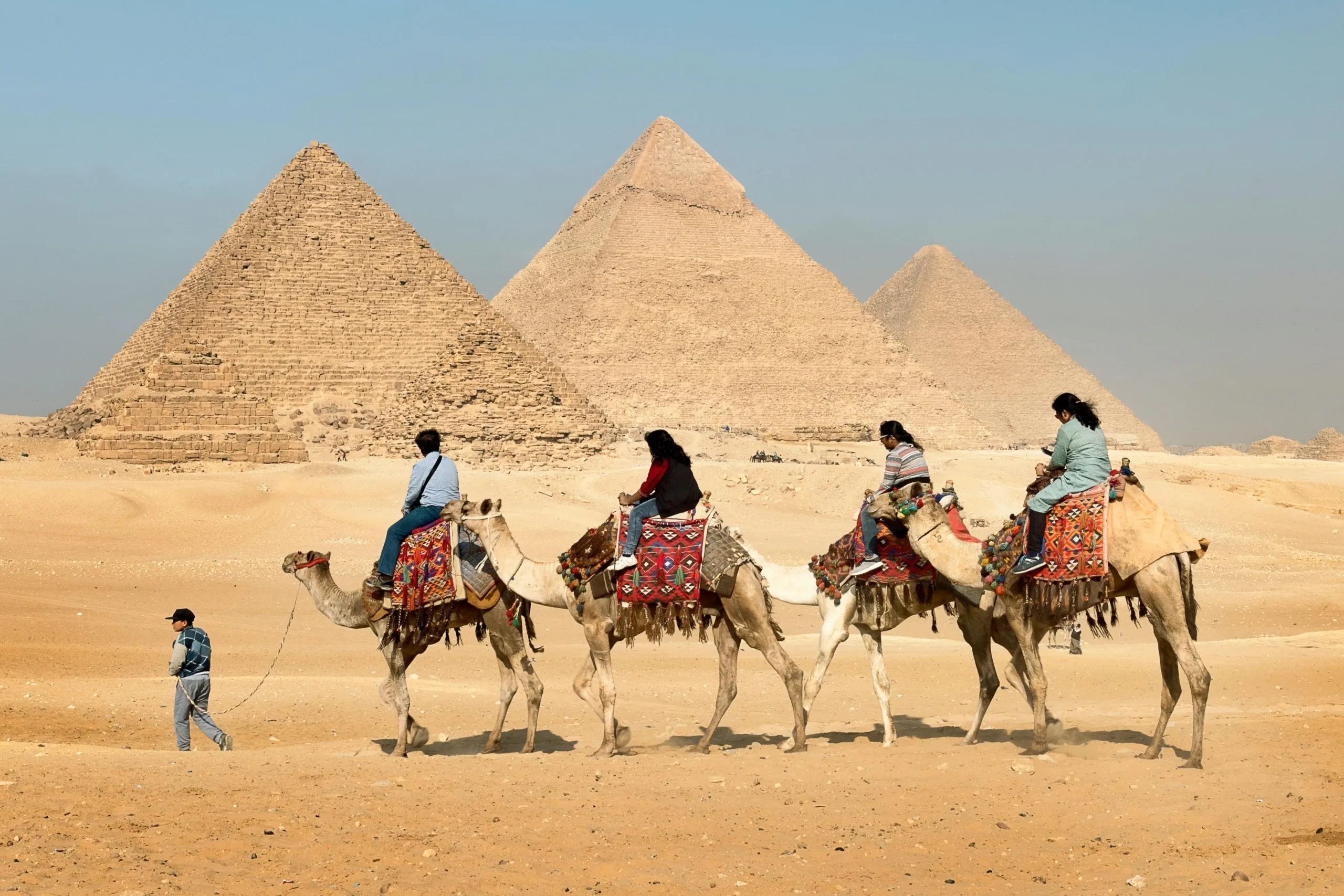
The most famous is Khufu, who ordered the Great Pyramid at Giza. That pyramid once had smooth white casing stones and a shining capstone. You can learn more about the whole site in this detailed article on the Pyramids of Giza.
Building such massive tombs took a strong central government. Officials organized workers, food, stone quarries, and transport. Most workers were not slaves in chains, but farmers doing state work during the flood season when fields were underwater.
Over time, pyramid building slowed. Huge projects cost a lot, priests gained power, and local governors began to act more independent. The Old Kingdom ended with a long period of drought, hunger, and political breakup.
Middle Kingdom and New Kingdom: golden age of empire and famous rulers
After a rough patch, Egypt pulled itself back together in the Middle Kingdom. Kings restored order, fixed irrigation systems, and reopened trade routes. Art and literature flourished, and tombs show calmer, more balanced scenes of daily life.
Later came the New Kingdom, often seen as Egypt’s golden age. Egypt had a strong army, rich temples, and famous rulers whose names you probably know:
- Hatshepsut, a female pharaoh, ruled as king, wore the royal beard, and built grand temples while focusing on trade more than war.
- Akhenaten tried to change traditional religion by focusing on one main god, the Aten, shown as a sun disk with rays.
- Tutankhamun, often called King Tut, died young, but his tomb was found almost untouched, packed with gold and daily objects.
- Ramses II ruled for decades, fought major battles, and filled Egypt with statues of himself.
Their time was full of giant temples, ambitious building, foreign wars, and contact with other powerful states.
Foreign rule, Cleopatra, and the end of ancient Egyptian power
By the later New Kingdom and after, things got harder. Egypt faced invasions, internal fights, and money problems. Foreign powers such as the Assyrians and Persians took turns controlling the land.
In the 4th century BCE, Alexander the Great, a Macedonian Greek, conquered Egypt. After his death, one of his generals started the Ptolemaic dynasty. These rulers were Greek on paper but ruled from Egyptian soil and used many Egyptian symbols.
Cleopatra VII was the last of these Ptolemaic rulers. She spoke several languages, including Egyptian, and tried to keep her kingdom strong by forming alliances with Roman leaders like Julius Caesar and Mark Antony. After her death and Rome’s victory, Egypt became a Roman province.
Traditional temples and hieroglyphs slowly faded, replaced by new religions and scripts, but Egyptian ideas and symbols never fully disappeared.
How We Learn About the Old Egyptians Today
Ancient Egypt is not just old stories. Researchers still update what we know, using both old stones and new science.
Hieroglyphs, the Rosetta Stone, and reading lost stories
Hieroglyphs are picture-signs used for religious texts, royal names, and important records. After Egypt adopted other scripts and later religions, people forgot how to read them. For centuries, the walls of temples looked like silent art.
That changed with the discovery of the Rosetta Stone in 1799. The stone has the same text written in three scripts: hieroglyphic, Demotic, and ancient Greek. Since scholars could read Greek, they used it as a key to unlock the others. The story of how Jean-François Champollion cracked this code is told in detail in this history of the Rosetta Stone from Britannica.
Thanks to that puzzle, we can now read names like Tutankhamun and Ramses II on statues, coffins, and temple walls.
Tombs, mummies, and what archaeology still finds in Egypt
Egyptian tombs and mummies act like time capsules. The dry climate, deep tomb shafts, and careful burial methods kept bodies, clothes, food, and tools in amazing condition.
In 1922, Howard Carter found Tutankhamun’s tomb in the Valley of the Kings, packed with treasures and simple things like board games and sandals. Finds like this show what people wore, ate, and believed about the afterlife.
Archaeologists still work at places such as Saqqara and Luxor. They often find smaller tombs, workshops, and everyday items, but each find fills in another piece of the story. Recent work has even brought new surprises, like large fortresses from the New Kingdom and fresh tombs with colorful paintings, as described in this roundup of recent archaeological discoveries in Egypt.
Modern science adds more layers, from DNA studies to 3D scans of mummies, showing that the history of the old Egyptians is still growing.
Conclusion
From small Nile villages to giant stone pyramids, the history of the old Egyptians stretches across millennia. We followed it from early farmers and the first pharaohs, through the age of pyramids, the rich courts of Hatshepsut and Ramses II, and finally to Cleopatra and the arrival of Rome. We also saw how lost writing came back to life through the Rosetta Stone and how new digs keep adding fresh details.
Maybe that is why Ancient Egypt still feels alive today. Its temples, tombs, and mummies are quiet, but the stories around them keep changing as we learn more. If something here caught your attention, pick one topic and go deeper: the pyramids at Giza, the short life of Tutankhamun, or the strange reign of Akhenaten. The old Egyptians left more clues than almost any ancient culture, and they are still waiting for curious minds to explore them.